Boukreev’s life-before-summit principle
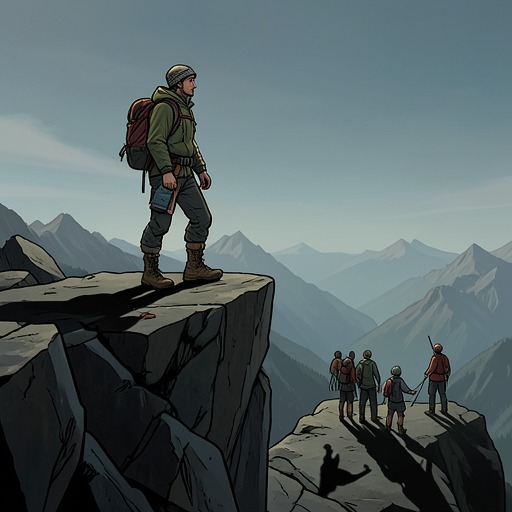
The ClimbBoukreev’s life-before-summit principle is the conviction that a summit is never worth a human life. In his account, it is not an abstract rejection of ambition but a practical ethic: prepare carefully, preserve strength, respond to danger, and refuse to promise that experience can control the mountain. Its force lies in the tension between the summit as a shared objective and each climber’s responsibility to survive.
Definition and Ethical Ground
Boukreev describes his mountaineering tradition as treating climbing as a reasonable sporting endeavor, not a game of Russian roulette. Above eight thousand meters, he argues, the margin of safety decreases sharply even for a well-conditioned amateur. A team member’s death therefore remains a failure that outweighs any success at the summit. In this formulation, achievement is measured not only by reaching the top but by what the pursuit demands of the people undertaking it.
The principle does not erase personal ambition. Boukreev acknowledges that climbers want to test their abilities and pursue difficult objectives; he, too, wanted opportunities to explore his own capabilities. But ambition cannot guarantee an outcome. On Everest, he writes, even thorough preparation leaves climbers short of what they need on summit day, when altitude, physical debility, and natural conditions combine beyond anyone’s control.
Preparation and Decisions on Everest
The principle appears first as a method of managing effort. In the acclimatization plan Boukreev and Scott Fischer developed, the clients would carry only personal belongings and equipment on their first excursion to 6,100 meters, while climbing Sherpas under Lopsang Jangbu Sherpa carried rope and supplies. The group would return to Base Camp that same day, rest, and assess the clients before proceeding. Later excursions likewise alternated higher exposure with descent and recovery, rather than treating upward progress as an end in itself.
The ethic also operated amid competing obligations. When Sherpas were exhausted and Camp III remained unfinished, the expeditions had agreed to cooperate on fixing the route between Camps III and IV. Mountain Madness faced a choice: send its Sherpas to establish Camp III and leave none available for the shared rope work, or contribute Boukreev in their place. The team chose the latter in part to retain its place among the early summit bids. Boukreev welcomed the task because he wanted the route ready and safe, but the episode also shows how safety work and pressure to preserve a summit opportunity could become entangled.
On summit day, the principle met a less orderly reality. The Fischer and Hall clients had expected the Sherpas to fix the ropes above Camp IV before the clients set out, but no Sherpas had left early to do so. The delay and uncertainty confronted climbers already moving through the Death Zone. Meanwhile, Fischer had not set a definite summit-day turnaround time for his clients. His plan instead relied on Lopsang Jangbu Sherpa, Boukreev, and Neal Beidleman alternating at the front, with Fischer bringing up the rear and turning back stragglers; only Fischer could make radio contact with Lopsang. The arrangements left safety dependent on a moving group, imperfect communications, and judgments made on the mountain rather than on a single clear deadline.
Oxygen, Rescue, and the Meaning of Descent
The principle is central to Boukreev’s explanation of why he descended ahead of some clients without supplemental oxygen. Before the expedition, he and Fischer had agreed that Boukreev would guide without oxygen if he was properly conditioned and acclimatized. The clients, by contrast, were to have three canisters each, intended to provide eighteen hours of oxygen for a midnight departure, a summit bid, and a return to Camp IV by 6:00 P.M. Fischer had hired Boukreev partly for his ability to bring help—oxygen, hot drinks, or physical assistance—to climbers descending in difficulty. In that arrangement, Boukreev’s descent was part of the rescue plan, not a withdrawal from responsibility.
Boukreev therefore objected to the way Jon Krakauer linked his lack of oxygen to his descent ahead of the clients. He said he went down when he did because the clients were the ones who might run out of oxygen before reaching Camp IV, greatly increasing their danger. The distinction matters to the principle: reaching the summit is subordinate to the living climbers’ return, and a guide’s movement down the mountain can be a means of helping them rather than evidence that their welfare has been abandoned.
Limits of the Guide’s Promise
After meeting the organizers of the Indonesian expedition, Boukreev warned that success was marginal: he estimated a 30 percent chance that one person would summit and a fifty-fifty chance of losing someone. He proposed a year of training on progressively higher peaks, but the proposal was rejected. The expedition’s coordinator assured him that the men were motivated, well conditioned, and committed even in the face of possible death. Boukreev accepted a role that would make use of his experience while still promoting the team’s independence, rather than presenting his expertise as a guarantee.
His later distinction between guiding and advising makes that limit explicit. He could be a coach, an adviser, or a rescue agent; he could not guarantee anyone’s success or safety against the combined force of natural circumstances and physical debility at high altitude. He considered each climber responsible for the decision to risk a life, while acknowledging that this position might be mocked. For Boukreev, the distinction was a protest against the promise of certainty in a place where no guide could deliver it.
The Principle’s Human Cost
On the Indonesian expedition, Boukreev watched climbers continue toward the summit despite serious concerns about their condition. Iwan had never seen snow until four months earlier and needed instruction in using his ice axe after falling on the ridge; Asmujiono was moving with his consciousness deeply impaired, while Misirin appeared to be in the best shape. Boukreev thought one man should continue and the others turn back, but allowed himself to be persuaded to postpone that decision until above the Hillary Step. He later judged the men as more committed to success than to life—a contrast that gives the principle its sharpest human stakes.
The next morning, Boukreev found Yasuko Namba’s body near the edge of the South Col, where he had left her during the previous year’s disastrous night. Her pack was gone, its contents scattered among the rocks and ice. He collected small belongings for her family, covered her body with stones, and left two ice axes as markers. These limited acts of respect could not undo the loss, but they made the aftermath part of the principle’s moral record: the dead remain more than the cost of a successful expedition.
Reflecting on the Indonesian climbers and on families who had lost loved ones, Boukreev worried that the expedition’s success would encourage other inexperienced people to enter the mountains. He also admitted that he had few alternatives for financing his own objectives. The tension is unresolved: he continued working with climbers while resisting the role of someone who could promise them a safe or successful ascent. The principle thus remains both a rule for action and a limit on professional authority—life comes before the summit, but the guide cannot remove the danger that makes the choice necessary.